

Tec-Do Organized MARS2 Workshop at ECCV 2026 to Advance Multimodal Reasoning for Agentic Commerce
MALMÖ, Sweden, Sept. 10, 2026 (GLOBE NEWSWIRE) -- ECCV 2026, one of the world’s premier conferences in computer vision and machine learning, is taking place in Malmö, Sweden, from September 8 to 12. Managed by the European Computer Vision Association (ECVA), the conference brings together the global research and technology community, with major sponsors including Google, Meta, Apple and Amazon.
On September 9, Tec-Do led the 2nd Multimodal Reasoning and Slow Thinking in the Large Model Era (MARS2) Workshop, the only Agentic Commerce-focused workshop among all workshops at this year’s ECCV to be led by a Chinese technology company.
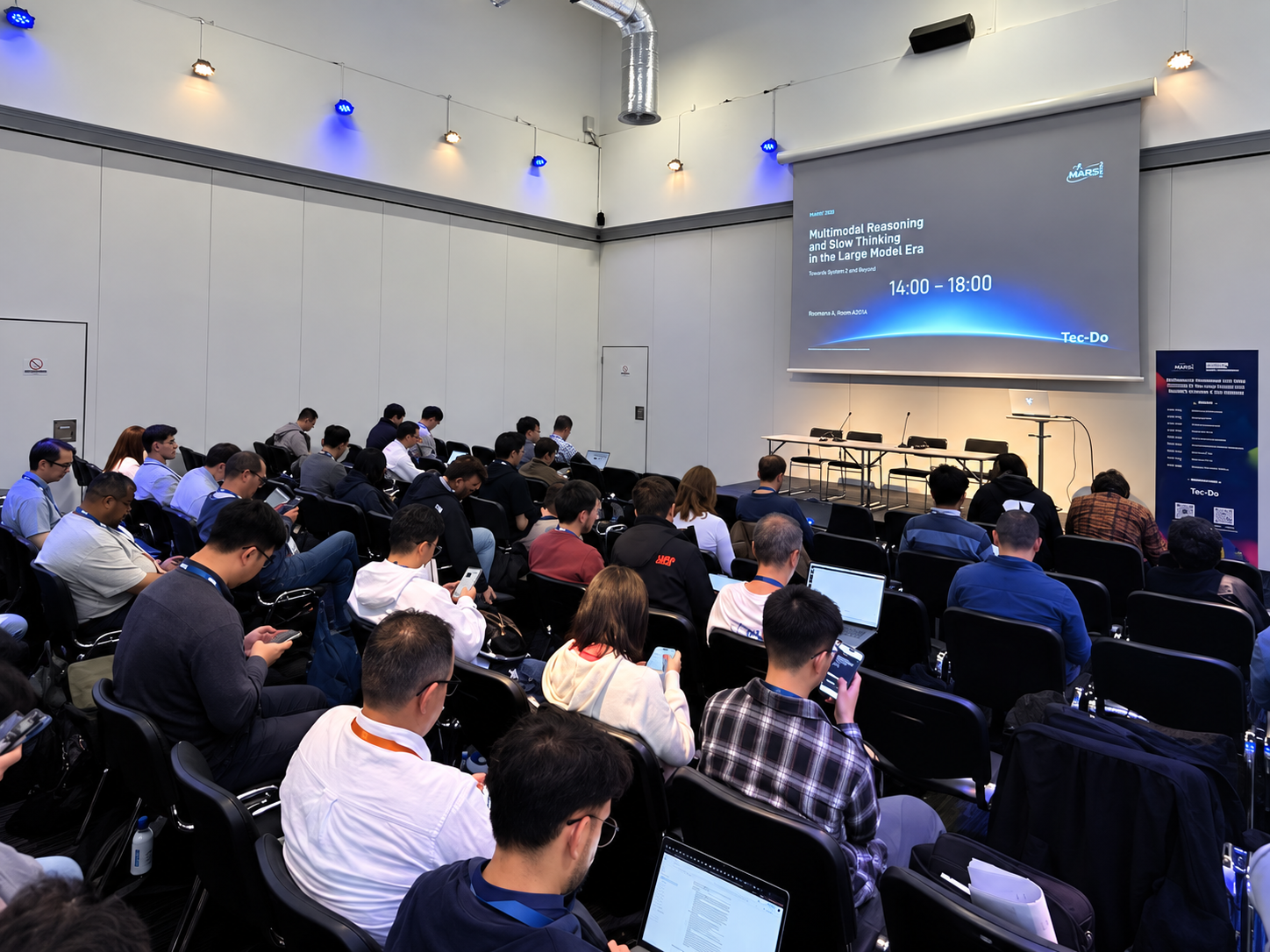
MARS2 brought together leading academic expertise from around the world. Its organizing committee included researchers from Tsinghua University, the University of Oxford, Nanyang Technological University, Seoul National University and other institutions. Invited speakers included Paul Pu Liang of MIT, Yarin Gal of the University of Oxford, Shanxin Yuan of Queen Mary University of London, and other internationally recognized scholars, who shared perspectives on frontier topics including multimodal reasoning, long-chain reasoning, zero-shot generalization and agentic systems.
Under the theme “Multimodal Reasoning and Slow Thinking in the Large Model Era: Towards System 2 and Beyond,” the workshop explored how AI can move beyond perception-oriented “fast thinking” toward more deliberate “slow thinking” and higher-order reasoning.
This transition is particularly important for Agentic Commerce. As AI agents take on a greater role in commercial decision-making, they need to do more than understand content — they must identify relevant evidence, reason across multiple modalities and explain how decisions are made.
Beyond academic discussion, MARS2 hosted a multimodal reasoning challenge with a total prize pool of US$100,000 across three tracks: Multimodal Advertisement Comprehension (MAC), Video Temporal Grounding (VTG), and Marketing Strategy Decoding and Conversion Analysis (MDC). Together, they evaluated capabilities spanning holistic understanding, evidence localization and higher-order reasoning.
The competition attracted 64 teams worldwide and more than 1,060 submissions, including researchers from the University of Science and Technology of China, Nankai University and Sun Yat-sen University, as well as technical teams from ByteDance, JD.com and Xiaohongshu (RedNote). Award-winning teams presented their approaches and key findings during the workshop.
Technical solutions from the competition were compiled into the report “2026 Challenge on Multimodal Reasoning: From Multimodal Perception to Complex Reasoning.” The M-CAR benchmark dataset and full codebase have also been open-sourced on GitHub to support reproducibility and further research by the global AI community. For more information, please visit: https://mars2workshop.github.io/eccv2026/.
The challenge results also highlighted several emerging directions for multimodal AI.
Models generally performed well on perception-oriented “System 1” tasks, but performance declined significantly when tasks required multi-step reasoning, temporal causal attribution and other forms of “System 2” reasoning, highlighting the remaining gap between multimodal perception and reliable higher-order reasoning.
The experiments also suggested that improving modality coverage and input quality can sometimes be more effective than simply scaling model size. In one ablation study, introducing an audio-event timeline with cross-modal temporal alignment improved localization performance by 16.7 points, while increasing model parameters from 4B to 8B delivered only marginal gains.
Meanwhile, top-performing solutions used techniques including Proposer-Critic dual-model validation, coarse-to-fine localization and adaptive token allocation. Despite different implementations, these approaches shared a common principle: stronger reasoning depends not only on model scale, but also on how evidence is acquired, aligned and verified.
Taken together, the findings point toward a more practical direction for Agentic Commerce: building traceable, verifiable and evidence-grounded reasoning pipelines that can support real-world commercial decisions.
Dr. Tracy Chen, CTO of Tec-Do, said: “The success of the MARS2 Workshop reinforces our view that AI agents are moving from concept into real-world commercial scenarios. Marketing is one of the few domains that both requires sophisticated intelligence and allows outcomes to be validated rapidly. Tec-Do will continue connecting frontier academic research with real industry needs, helping accelerate the deployment of AI technologies in commercial environments.”
In her closing remarks, Maeve Zhang, Vice President of Branding and PR at Tec-Do, said: “The discussions at MARS2 demonstrated how frontier technologies can address real-world business challenges. We hope to further bridge the gap between academic research and commercial deployment, working with researchers worldwide to explore more reusable and scalable approaches to Agentic Commerce.”
As the lead initiator of the MARS2 Workshop, Tec-Do has also developed its own AI technology foundation for global marketing. In January 2026, its proprietary Tec-Chi reasoning model scored 85.82 in the SuperCLUE advertising and marketing benchmark, ranking first globally. In July, its Tec-Chi content-understanding model scored 86.43 in the SuperCLUE overseas marketing video-understanding benchmark, placing second overall.
Today, Tec-Do’s proprietary Tec-Chi multimodal large models and Navos marketing multi-agent platform serve more than 100,000 advertisers expanding globally, with operations spanning more than 200 countries and regions.
Building on MARS2, Tec-Do will continue advancing Agentic Commerce through industry-scale applications while using initiatives such as the MARS2 challenge series and the open-source M-CAR benchmark to translate real commercial scenarios into meaningful research challenges for the global AI community.
About Tec-Do
Founded in 2017, Tec-Do is a leading AI marketing company delivering results-centric marketing solutions for global business growth. Powered by Tec-Chi multimodal large language models (MLLMs) and Marketing Multi-Agent Platform Navos, the company delivers end-to-end marketing solutions through a suite of AI-native, performance-driven products. These products restructure and autonomize mission-critical marketing processes—including market intelligence, content generation, campaign delivery, and performance optimization—across global media channels. In 2025, Tec-Do served over 100,000 advertisers, representing a diversified customer base that spans e-commerce, gaming, entertainment, and local commerce.
For more information, please visit https://www.tec-do.com/en/.
Media Inquiries:
johnny.guan@tec-do.com
A photo accompanying this announcement is available at https://www.globenewswire.com/NewsRoom/AttachmentNg/d289546a-5126-4204-a942-5449b44ca3d7

TecDo Hosts MARS2 Workshop at ECCV 2026
MALMÖ, Sweden – Sep. 9, 2026 – Attendees at the MARS2 Workshop, hosted by TecDo Technology Co., Limited during ECCV 2026. (Photo: TecDo Technology Co., Limited)
Legal Disclaimer:
EIN Presswire provides this news content "as is" without warranty of any kind. We do not accept any responsibility or liability for the accuracy, content, images, videos, licenses, completeness, legality, or reliability of the information contained in this article. If you have any complaints or copyright issues related to this article, kindly contact the author above.
